How to build a minimum post-deploy verification loop
A deployment only changes state. It does not prove the public site still works. Teams often stop too early because the build passed, but the real question starts after release: can a reader still reach the important public surfaces without friction?
Use the web automation and ops systems unit page as the index for follow-up posts on release gates, reporting loops, and review automation. If you need the broader baseline first, start with the rules you should fix first. If your first gate still ends at RSS and sitemap files, continue with the feed and sitemap release gate guide.
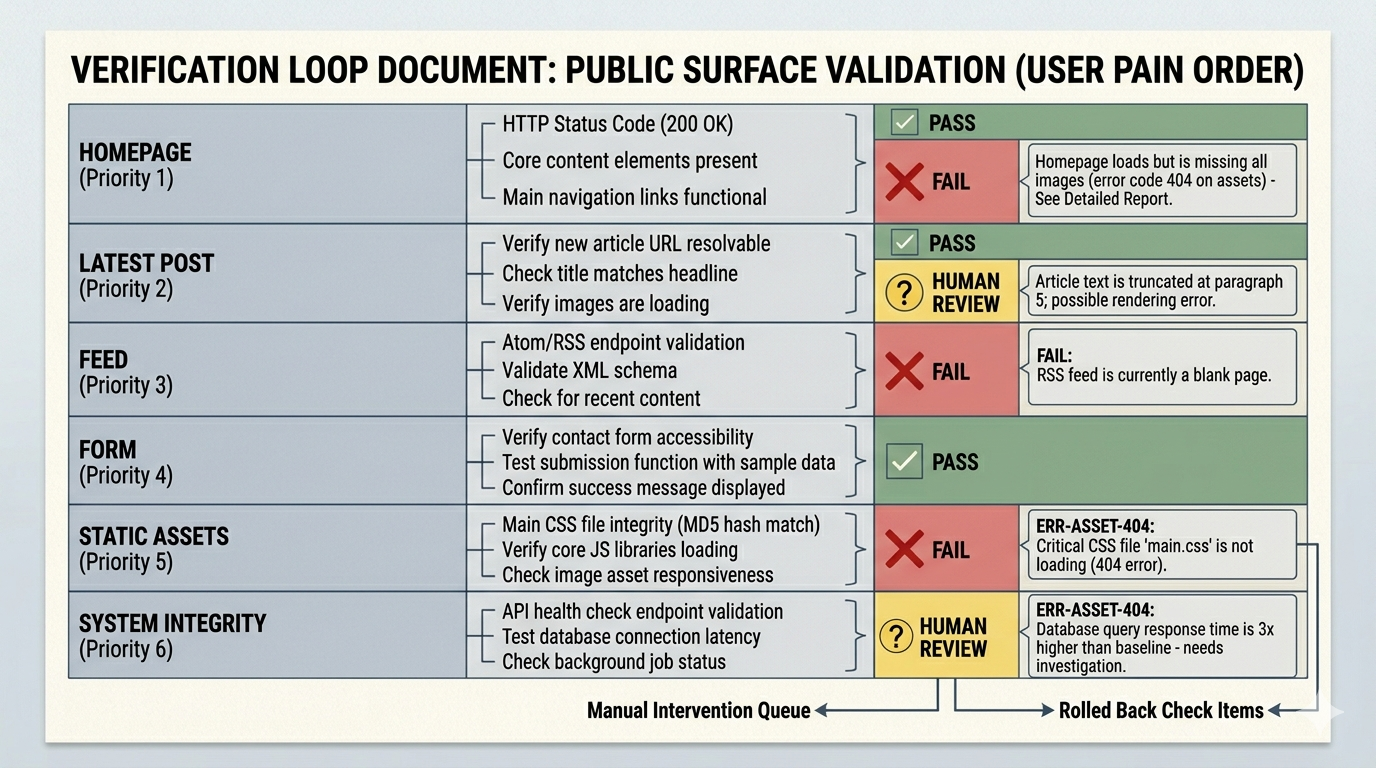
1. Check the public surface in user pain order
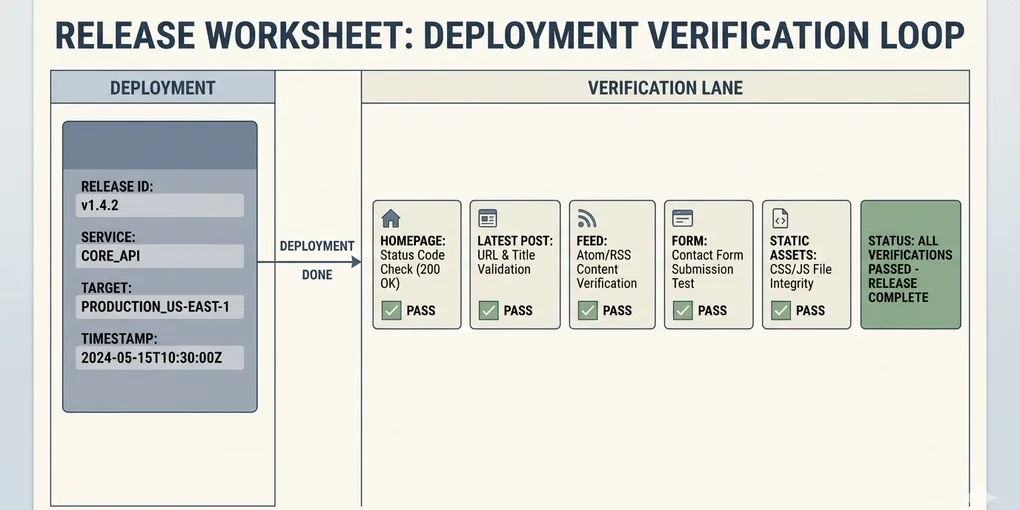
The right order is not “whatever is easiest to script.” The right order is what breaks the user experience first. That usually means homepage, latest post, feed URL, one form path, and one critical static asset.
A broken homepage hurts before a broken long-tail page. A broken form hurts before a perfect log panel helps. The loop should follow that reality.
2. Each check must end with one of three states
A good verification step is not vague. Every item should end with pass, fail, or human review. That makes the loop easier to automate later and easier to stop when something is genuinely broken.
- Pass: the public check is healthy
- Fail: release should stop or alert immediately
- Human review: the signal is unclear and needs a person
3. Keep the first loop small enough to survive every release
The minimum loop should be cheap enough to run after every deployment. If you start with fifteen checks, the team will skip them under pressure. Five is usually enough to begin.
A practical starting set is this:
- Homepage returns the expected public response
- Latest post opens correctly
- Feed or sitemap URL responds as expected
- One critical form or submission path still works
- One critical static asset still loads
4. Write the manual loop first, then automate the stable parts
Automation should come after the loop is understandable by a human. If the team cannot explain the manual order yet, the script will only hide confusion.
Once a check has repeated cleanly enough, move it into automation. Keep the unstable or ambiguous checks in human review until the signal becomes clear.
5. Recovery should be part of the loop, not an afterthought
A release check without a recovery path creates noise. For each fail state, decide the immediate next action: rollback, pause rollout, or open investigation. That keeps the loop actionable instead of ornamental.
What to do first
Write down the five checks you already do after a release, then reorder them by user pain. Add only three outcomes to each one: pass, fail, or review. That list is your minimum post-deploy verification loop.